

More than a year after the arrival of Pope Leo XIV…
Just a month ago, we were celebrating the first anniversary of the election of the American and Peruvian cardinal, Robert Francis Prevost, as the 267th successor of Peter, who took the name Leo XIV. The first pontiff from the United States, with a Peruvian soul after having lived for more than 22 years in that Latin American country. An Augustinian, prior general for two terms, an expert in mathematics, languages, and canon law; a parish priest and bishop in marginalised communities in Peru and cardinal prefect of the Dicastery for Bishops.
That election was undoubtedly a surprise to many, but it soon revealed how the Holy Spirit had sent us the most suitable shepherd to lead the Church in difficult times, in what many call a “change of era” or the “fourth industrial revolution.” A Pope who has placed at the heart of his ministry: unity in Christ, closeness to the poor and the most vulnerable, the defence of human dignity in the face of the challenges posed by technological development and, in particular, a strong call for peace; that “unarmed and disarming” peace of which he spoke to us from the very first day.
The Pope of Unity
Pope Leo XIV’s motto, “In illo uno unum” (“In the one Christ we are one”), was taken from a homily in which St. Augustine explains that, although there are many Christians, in the one Christ we are one body. The Holy Father decided to keep this motto, which he had already used as a bishop, as an invitation to communion and unity within the Church and as a sign of hope.
Unity is something that must be pursued and built. “In the unity of faith, proclaimed since the beginning of the Church, Christians have been called to walk in harmony, guarding and transmitting the gift they have received with love and joy”, the Pope recently affirmed in his message marking the 1,700th anniversary of the Council of Nicaea.
“Dilexi te” and a Focus on the Most Vulnerable
Robert Prevost’s missionary experience in Peru, where his ministry took place in direct contact with “the poorest and the forgotten peoples,” has defined the style of his pontificate, grounded in the conviction of God’s universal love for all, without distinction, and with a clear commitment to the most vulnerable. He is, without a doubt, a missionary pope who is attentive to the problems and suffering of those living in difficult circumstances.
His choice of name, a direct reference to Pope Leo XIII, author of Rerum novarum, the Catholic Church’s first social encyclical, reflects his conviction regarding the Church’s prophetic role in proclaiming and giving witness to the Gospel in the world’s crises.
Thus, on October 4, he signed his first apostolic exhortation, Dilexi te (“I Have Loved You”), on the divine and human love of Christ’s heart toward the poorest. This exhortation, a project initiated by Pope Francis, speaks of service to the poor, in whose faces we find “the suffering of the innocent” and in whom “the very body of Christ” is made present. The text denounces an economy that kills, the absence of equity, violence against women, malnutrition, the educational crisis and the “structures of injustice” that must be “destroyed by the power of good.”
Dilexi te invites us to renew the Christian community to make it more welcoming, merciful and committed to the most vulnerable.
The Pope of Peace
As we have repeatedly stated, this has undoubtedly been the most defining characteristic of Leo XIV’s pontificate, ever since he appeared in St. Peter’s Square, on May 8, 2025, with his call for “the peace of the resurrected Christ, a peace that is unarmed and disarming, humble and persevering.” A peace that builds bridges and emerges as a transformative force for humanity.
In the face of today’s conflicts, Leo XIV has repeatedly insisted that wars are not resolved through more violence but through dialogue. He has persistently called for a ceasefire in conflict zones, disarmament, for leaders to prioritise negotiation, and for nations to find solutions that respect the dignity of all. His diplomatic efforts have been intense, aimed at “seeking nonviolent responses and solutions that are more effective and better for the people.”
With his clear, “unarmed and disarming” but firm and persevering voice, he never stops demanding an end to violence and war. He has made strong appeals, such as “Never Again War” in his first Regina Caeli and his accusation against the warlords whose hands “are stained with blood” during the Palm Sunday Mass. In the name of peace, Leo XIV met with representatives of Hezbollah in Lebanon and received the presidents of Palestine and Israel. He has held telephone conversations and meetings with various leaders of nations at war.
It is on the issue of the war in Iran that the Pope has spoken with the strongest and most determined words, taking the unusual decision to explicitly name a president, and denouncing any religious or ideological justification for the conflicts. In Cameroon, Leo XIV stated that the world is being “ravaged by a handful of tyrants” and harshly criticised corruption.
But above all, the Pope reminds us that peace, which comes from God who loves us all unconditionally, begins in the heart of every person, and that it is not enough to call for peace in the world if it is not cultivated in our daily lives. Warning us of the danger of becoming indifferent to violence, he has asked us to rid our hearts, minds, and lives of hatred and revenge; to educate for fraternity; to promote forgiveness and reconciliation and to build relationships based on respect and solidarity. As he recently said, “Peace begins with each one of us, with the way we look at others, listen to others and speak to others.”
His message has been clear: peace is not merely the absence of conflict, but the fruit of justice, fraternity, and the recognition of the dignity of every human person.
A Pope who is deeply engaged in and concerned about safeguarding the human person in the face of Artificial Intelligence: “Magnifica humanitas”
As an expert in the digital world, he stated at his first consistory: “Today, the Church offers everyone the treasure of its social doctrine in response to a new industrial revolution and advances in the field of artificial intelligence, which pose new challenges for the defence of human dignity, justice, and work.” Sometime later, he would publish Magnifica humanitas, the first encyclical of his pontificate on the protection of the human person in the age of artificial intelligence.
The encyclical urges humanity to “disarm” artificial intelligence and the ways in which technologies are developed and used. This “disarmament” does not mean rejecting innovation, but rather moving away from systems based on domination, profit and control to build a civilization of love in which human dignity, freedom, solidarity, subsidiarity and care for creation can flourish.
The Holy Father is not opposed to technological progress, but he calls for greater discernment, clarity and responsibility in the way artificial intelligence and new technologies are designed and applied; these must be grounded in truth, the common good and human dignity, with special attention to three areas: communication, education and work. We will talk about all this later.
Well, there is no doubt that, with his discreet and serene style, “unarmed and disarming”, but at the same time firm and courageous, his keen intelligence, his ability to observe and listen attentively and, of course, his intense inner life and dedication, Leo XIV continues to surprise us. He has given us so much in such a short time!!
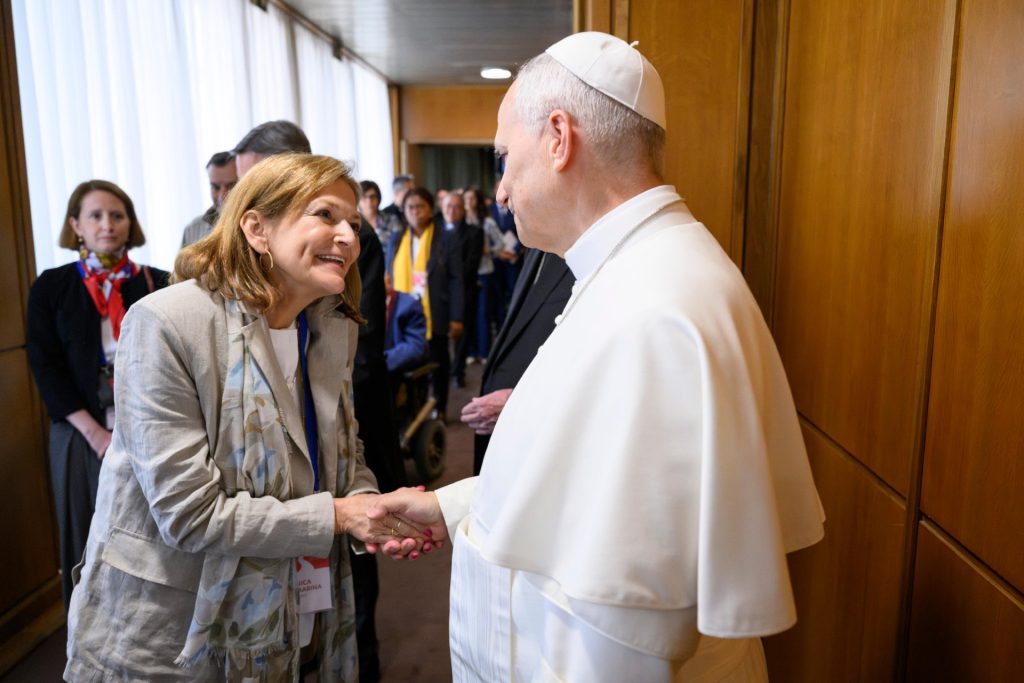
A few weeks ago, I had the wonderful opportunity to see him, listen to him and greet him. With his gentle smile and attentive gaze, he transmitted me a great sense of peace; that peace he speaks of so often and which surely comes from God, who lives in his heart. I told him that more than 8 million women from WUCWO were praying for him. I’m counting on all of you for this!!! We will keep the conversation.
Mónica Santamarina
WUCWO President General